
Currentage Associates Office No. 6, Select One Plaza, Adjacent to Sindh Bank, F-11 Markaz, Islamabad
+92-334 5344 044
info@currentageassociates.com
If you look at how Islamabad has grown over the past decade, one pattern becomes obvious: expansion is no longer happening inward, but it’s pushing outward.
The city’s traditional sectors are no longer the only focal point. Development is moving along motorways, toward new interchanges, and into areas that were once considered peripheral. That outward shift isn’t temporary. It’s how the next phase of the region is being built. This is where Faisal Town Phase 2 fits in.
It’s not designed as a “live today” project in the conventional sense. Instead, it’s positioned as something more forward-looking. A development aligned with where the city is heading, not where it has already settled.
Some projects are built for immediate use. Others are built for the direction of growth. Faisal Town Phase 2 clearly belongs to the second category.
One of the defining aspects of Faisal Town Phase 2 is its sheer scale. Spanning roughly 80,000 kanal, with additional expansion plans, it’s not just another housing society. It’s the kind of project that has the capacity to shape an entire zone over time. And scale changes how a project behaves.
Larger developments allow for more structured planning, wider roads, better zoning, and the ability to layer infrastructure in phases rather than forcing everything into a limited footprint. They also support long-term population growth, which directly impacts commercial activity, property value, and overall sustainability. But there’s another side to scale.
Projects of this size don’t develop overnight. They move in stages, often requiring patience from early investors. The trade-off, however, is that when they do mature, they tend to define the surrounding area rather than just exist within it.
To understand Phase 2, it helps to look at where it’s coming from. The earlier development, Faisal Town, built its reputation on a relatively simple formula: deliver infrastructure, maintain affordability, and keep development moving. That approach earned trust in a market where delays and overpromising are common.
Phase 2 carries that same foundation forward, but it’s not just a repetition. Developed by Faisal Town Pvt. Ltd. under Chaudhry Abdul Majeed, this new phase operates on a much larger and more ambitious scale. The vision here isn’t just to extend an existing project, but it’s to create a more expansive, long-term development aligned with future urban growth.
So while the credibility comes from past delivery, the scope is clearly aimed at something bigger.
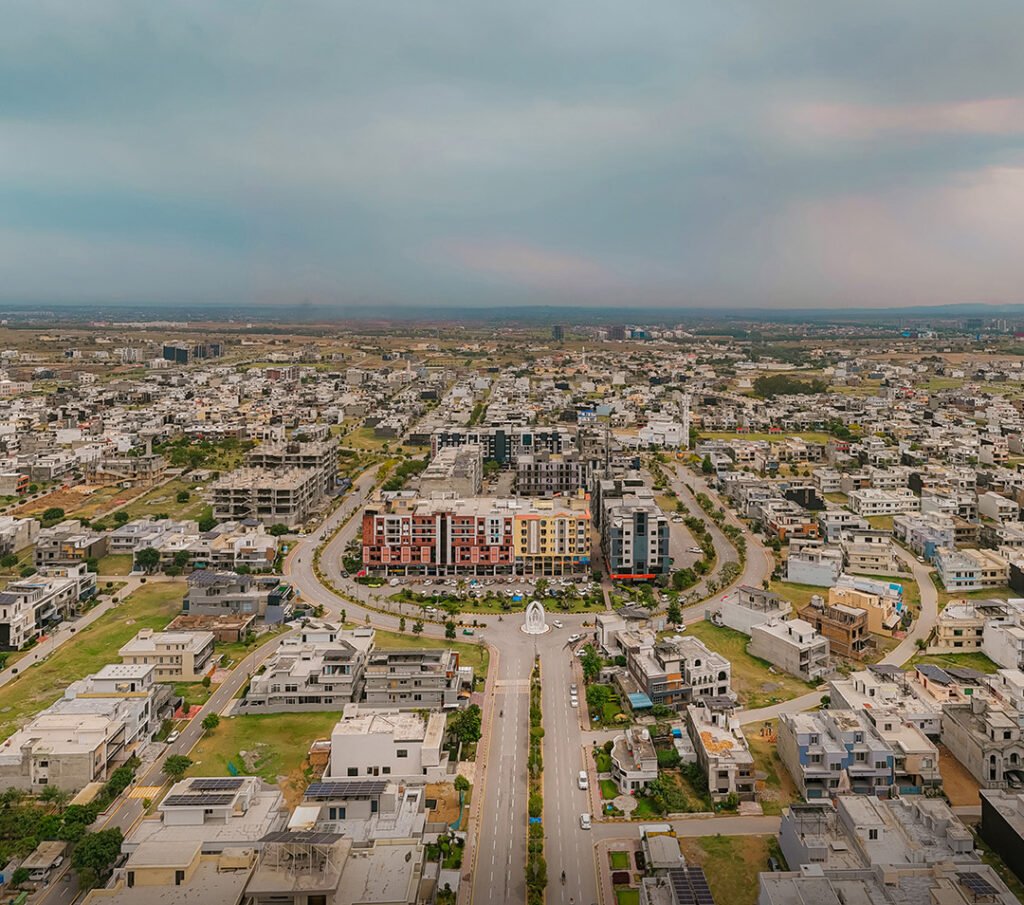
At its core, Faisal Town Phase 2 is a master-planned residential and commercial project designed to evolve over time rather than appear fully formed.
It’s positioned along key growth corridors, with connectivity built into its planning rather than added later. The involvement of international planning expertise also reflects an intent to structure the project at a level beyond typical local developments.
This combination, strategic placement, large-scale planning, and experienced development, sets the foundation for how the project is expected to evolve.
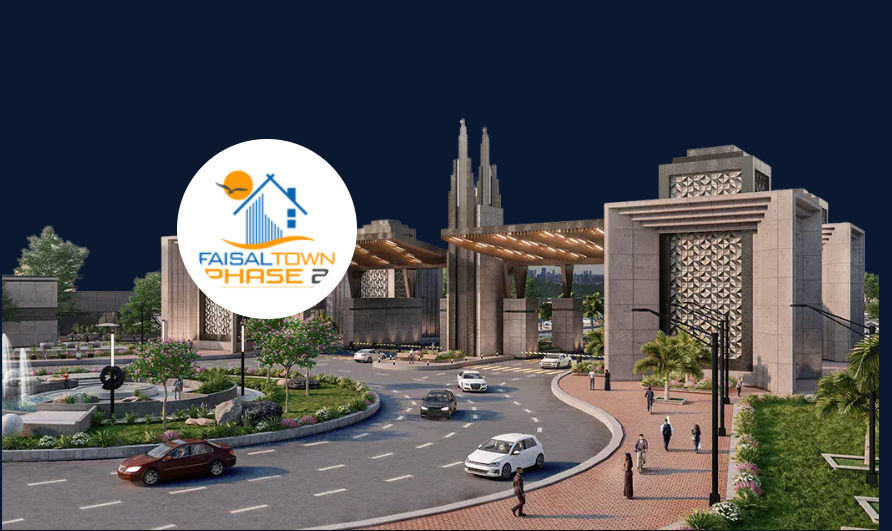
Location, in this case, isn’t about being central. It’s about being connected to what’s next. Faisal Town Phase 2 sits near the Thalian Interchange, with direct access to the M-2 Motorway. It’s also positioned close to Islamabad International Airport, which adds another layer of long-term value as surrounding infrastructure continues to develop.
Then there’s the Rawalpindi Ring Road, a major project expected to reshape traffic flow and connectivity across the region. Its linkage with Phase 2 places the society directly within a corridor that’s likely to see increasing movement, commercial activity, and urban expansion.
This isn’t central Islamabad, and that’s exactly the point. It’s part of the next ring of development, where the city is gradually extending itself.
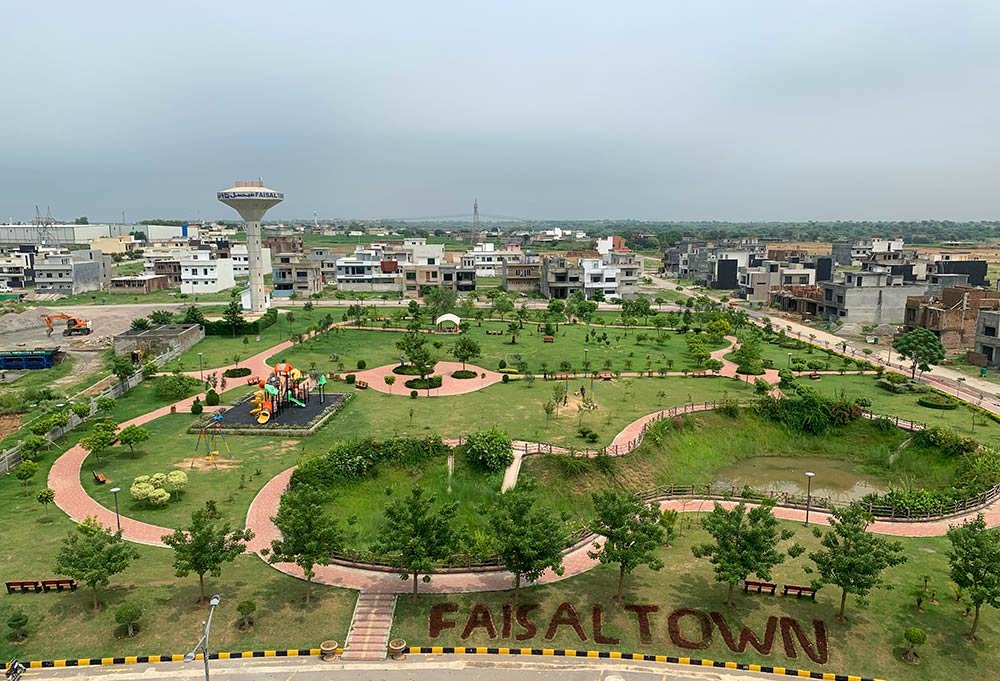
While Faisal Town Phase 2 is clearly positioned for the future, that doesn’t mean it exists only on paper. On-ground progress has already begun to take shape.
Large portions of land leveling have been completed, giving a clearer sense of the project’s layout. The development of a main boulevard, reportedly around 350 feet wide, indicates the scale at which internal infrastructure is being planned. Early road networks and structural groundwork are also visible in several areas.
It’s still early in the overall lifecycle of the project, and that’s important to keep in mind. But the presence of active development, even at this stage, helps bridge the gap between concept and execution.
At a distance, Faisal Town Phase 2 is easy to understand. It’s large, well-located, and aligned with future growth. But that’s only half the picture.
Because once you move beyond the scale and positioning, the real questions begin: how is the project structured internally? How do different blocks compare? And where do the actual opportunities lie within it?
At first glance, a project of this scale can feel like one continuous space. But once you look closer, Faisal Town Phase 2 is carefully divided into multiple sectors and blocks, each moving at its own pace. This division isn’t just administrative. It directly shapes how the project evolves.
Different zones are at different stages of development. Some are closer to early infrastructure rollout, while others are still in preparatory phases. As a result, timelines, pricing, and even buyer activity can vary significantly across the society.
It’s a key point that often gets overlooked: within a project this large, you’re not just choosing Faisal Town Phase 2, but you’re choosing a specific part of it.
Even before full development takes shape, certain areas begin to attract more attention than others.
In Faisal Town Phase 2, this pattern is already visible. The Overseas Enclave, for example, has drawn consistent interest due to its planned standards and positioning within the project. Similarly, model sectors like Sector O and Sector N have started to emerge as focal points for buyers looking to enter earlier but with some level of directional clarity. This kind of clustering is typical in large-scale developments.
Demand doesn’t spread evenly, but it concentrates in pockets first. Those pockets then often set the tone for future growth, influencing pricing and development momentum in surrounding areas.
One of the strengths of Faisal Town Phase 2 lies in its flexibility. The project offers a range of residential plot sizes designed to accommodate different types of buyers, from smaller plots suited for first-time investors to larger options intended for long-term home construction or asset holding.
Alongside residential zones, commercial plots are strategically placed along main boulevards and high-traffic corridors. These areas are expected to evolve into business hubs as population density increases over time. But here’s the more practical insight:
In early-stage projects like this, experienced investors don’t just choose what to buy, but they focus on where within the project to buy. Location inside the society often matters more than the category of the plot itself.
In projects of this size, infrastructure isn’t just about getting started, but it’s about sustaining long-term expansion.
Faisal Town Phase 2 reflects that approach in its planning. The road network is designed with wide main boulevards and structured internal streets that can support increasing traffic as the population grows. Drainage and sewerage systems are being laid out with scalability in mind, rather than being retrofitted later. Utility planning follows the same principle.
Instead of focusing only on initial connections, the infrastructure is being extended in phases, allowing the system to grow alongside the development itself. This kind of forward planning is subtle, but it plays a major role in how smoothly a project functions years down the line.
Amenities are often where early-stage projects can be misunderstood. In Faisal Town Phase 2, the master plan includes parks, educational institutions, healthcare facilities, and commercial hubs, all essential components of a complete residential ecosystem. But it’s important to separate what’s planned from what’s currently available.
At this stage, most of these facilities are part of the long-term vision rather than fully operational features. And that’s not unusual.
In projects that are still developing, the timeline of amenities matters more than the list itself. Parks come as residential clusters form. Commercial areas activate as population increases. Schools and healthcare facilities follow demand. Understanding that sequence helps set realistic expectations.
One aspect that adds a more contemporary dimension to the project is the integration of digital systems.
Buyers have access to an online member portal where they can manage payments, track records, and maintain documentation. It’s a small detail on the surface, but it reflects a shift toward more structured and transparent management practices.
In a market where record-keeping and communication can sometimes be inconsistent, this kind of system adds a layer of clarity for investors.
It’s important to be clear about where Faisal Town Phase 2 stands right now. Development is active, but it’s still in progress. Land leveling has been carried out across large areas, and major infrastructure elements, like the main boulevard, are taking shape. However, the project is not yet at a stage where full-scale living is possible across most sectors.
Construction is ongoing, but residential activity hasn’t matured yet. For buyers, this means one thing: this is not an immediate living solution. It’s an early-to-mid stage development where the primary value lies in timing and future positioning rather than present-day usability.
Understanding how Faisal Town Phase 2 is structured gives you clarity on how it works. But that’s only part of the equation.
Because once you see the internal layout, the next question naturally follows. When is the right time to enter, and where within the project does that decision make the most sense? That’s where the conversation shifts from structure to strategy.
At its core, Faisal Town Phase 2 is not a short-term play. It’s a time-based investment.
Projects at this stage don’t deliver immediate returns or instant livability. Their value builds gradually, tied to how infrastructure develops and how the surrounding area evolves. Roads get completed, utilities expand, and eventually, the population begins to shift toward the project. That sequence takes time.
For investors, this means returns aren’t just about what you buy. They’re about when you enter and how long you’re willing to hold. The earlier the stage, the more patience required, but also the more room there is for long-term positioning.
Even at this stage, price behavior in Faisal Town Phase 2 is beginning to show recognizable patterns.
As development milestones are reached, such as land leveling, road infrastructure, or sector launches, prices tend to adjust accordingly. These revisions aren’t random; they reflect increasing confidence as the project moves forward. At the same time, demand isn’t evenly distributed.
Certain sectors, particularly those gaining early traction, are seeing more activity. This creates micro-markets within the project, where prices and demand can move faster than in less active areas. For buyers paying attention, these early signals offer insight into where momentum is building.
There’s a reason experienced investors often enter projects like Faisal Town Phase 2 before they fully mature. Early entry typically comes with a lower cost base. Prices are more accessible because much of the development, and therefore the perceived value, is still ahead. As infrastructure improves and the project gains recognition, that gap begins to close.
That’s where the upside lies. But it comes with a clear trade-off: delayed usability. You’re not buying for immediate construction or living, but you’re buying into a timeline. Understanding that trade-off is what separates calculated decisions from speculative ones.
A realistic view of Faisal Town Phase 2 also means acknowledging the risks. One of the key considerations is its approval status. Like many large-scale projects at this stage, the NOC (No Objection Certificate) is still in process rather than fully finalized. That’s not unusual, but it’s something buyers should factor into their decision-making.
Development timelines are another variable. While progress is visible, large projects naturally take years to fully materialize. Delays can happen, and expectations need to be aligned accordingly.
Then there’s market behavior. Early-stage projects often attract speculative activity, which can create short-term price fluctuations that don’t always reflect long-term fundamentals.
Among experienced investors, there’s a general understanding: projects like this often require a long-term horizon, sometimes 10 years or more, to fully realize their potential.
To understand where Faisal Town Phase 2 stands, it helps to place it between two familiar categories. Compared to fully developed societies, it’s clearly less ready. You won’t find immediate livability or fully functional infrastructure across the board. But that’s also where those societies lose their edge. Most of their growth has already been realized.
On the other end are purely speculative projects with little to no on-ground progress. They may offer low entry prices, but they often come with higher uncertainty. Faisal Town Phase 2 sits in between.
It carries more credibility than early-stage, unproven developments, largely due to the track record of Faisal Town Pvt. Ltd., while still offering the kind of upside that comes with entering before full maturity.
In a project where timing, sector selection, and pricing all vary, having the right guidance becomes critical.
Currentage Associates approaches Faisal Town Phase 2 with a strategy-first mindset. The focus is on helping clients identify which sectors are gaining traction, when entry makes sense based on market conditions, and how to avoid overpaying in high-demand pockets.
It’s less about pushing inventory and more about aligning decisions with long-term goals. Because in early-stage developments, clarity is often the most valuable asset a buyer can have.
Faisal Town Phase 2 isn’t for everyone, and that’s important to recognize upfront. It tends to align best with:
For these profiles, the project offers a structure that fits their timeline.
When you bring everything together, the identity of Faisal Town Phase 2 becomes clear.
It’s not an immediate solution. It’s not a fully realized community, at least not yet. But it is a project built around long-term expansion, structured planning, and a location that aligns with where the region is heading.
Its value isn’t in what it is today. It’s in what it’s positioned to become over time. And that distinction matters.
If you’re considering Faisal Town Phase 2, the next move isn’t to follow momentum. It’s to build clarity.
With the right information and the right perspective, you can approach the decision strategically, not reactively.
Not at this stage. The project is still under development, with infrastructure being built. It’s primarily suited for long-term investment rather than immediate construction or residence.
It is located near the Thalian Interchange on the M-2 Motorway, with access through Chakri Road and linkage to the Rawalpindi Ring Road, placing it in a future growth corridor.
While both are developed by the same company, Phase 2 is significantly larger and more ambitious. It’s planned as a long-term expansion project rather than a direct continuation of the earlier phase.
Areas like the Overseas Enclave and sectors such as O and N have gained early attention. Demand tends to cluster in specific zones even before full development is complete.
Price growth typically follows development progress. As infrastructure improves and demand increases in active sectors, gradual appreciation can occur, but it depends on timing and entry point.
The project offers a range of residential plot sizes along with commercial plots in designated areas. The variety allows both small and large investors to participate.
Faisal Town Phase 2 is best approached with a long-term mindset, often 8 to 15 years, since development and population settlement take time.
Yes, land leveling, main boulevard construction, and early infrastructure work are underway. However, the project is still in its early-to-mid development phase.
Selection depends on your goals, timing, and budget. Working with experienced advisors like Currentage Associates can help you identify better-positioned options within the project.